
History
Historic Pensacola and architecture: two centuries of buildings that tell a story
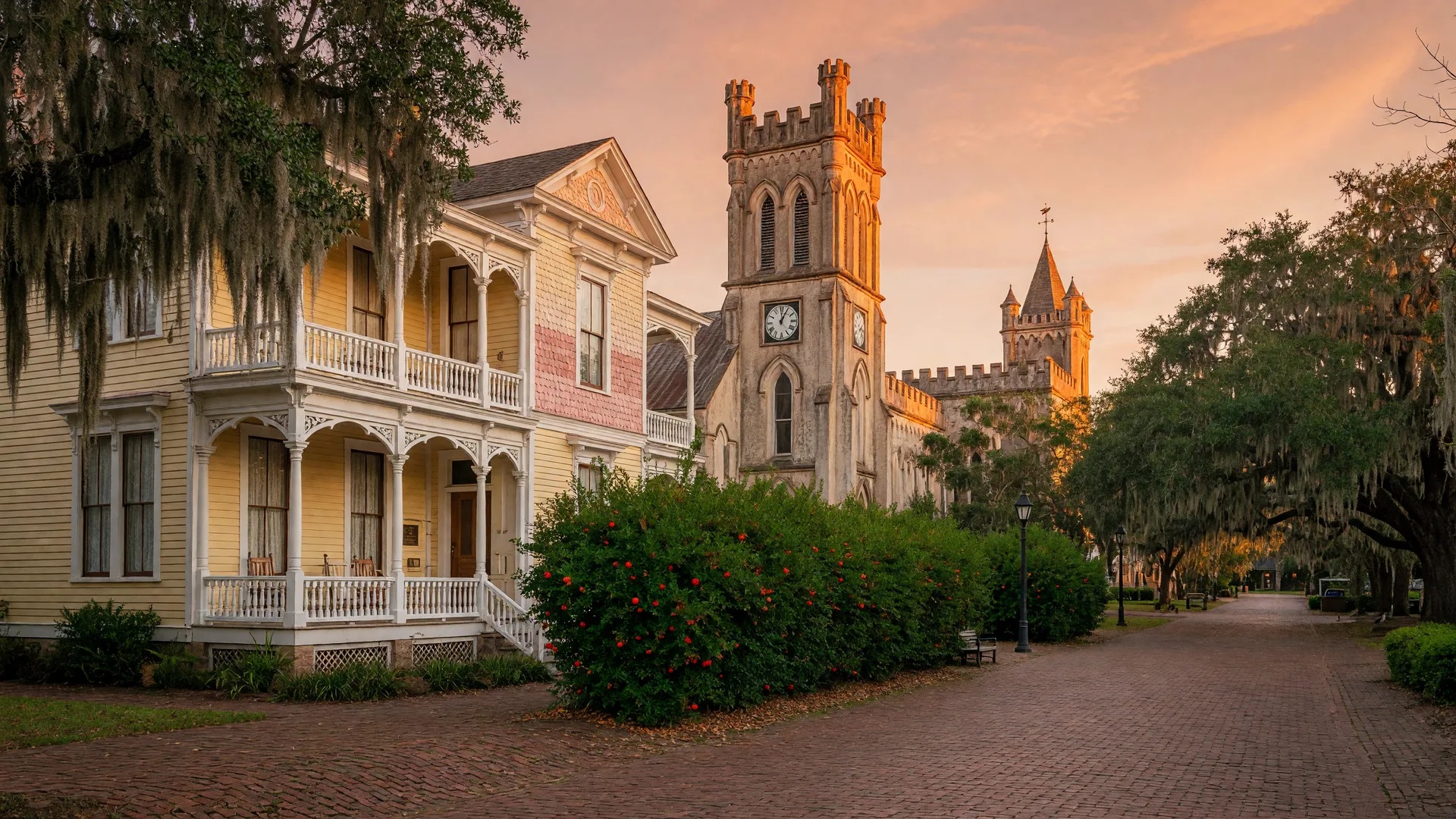
Seville Square, the streetscape that gave the estate its era
Pensacola is an argument that American history does not have to start in a single place. The Spanish landed in Pensacola Bay in 1559, a full six years before St. Augustine, and if that first colony was wrecked by hurricane within two years, the city that came after it never stopped building on the same harbor. Today, walk Seville Square to the front gate of 714 E La Rua St and you cross the entire story in under a mile: the Spanish settlement that began it, the British grid that still paces the streets, the 1781 siege that decided the Gulf, and the architecture of the lumber boom that built the estate itself.
The first American settlement, briefly
On August 15, 1559, the Spanish conquistador Tristán de Luna y Arellano brought roughly 1,500 settlers and soldiers on about a dozen ships into Pensacola Bayainer and founded a colony he called Santa María de Ochuse. It was the first multi-year European settlement attempt anywhere in what is now the continental United States, six years before St. Augustine and two decades before Roanoke. A hurricane destroyed his fleet at anchor within a month, a second storm scattered what remained, and by 1561 the survivors had been evacuated to Mexico. Pensacola Bay was abandoned, but the claim it left behind, that this is America's first settlement, is why the city calls itself \"the first\" to this day.
Spain did not return until November 1698, when it established the Presidio Santa María de Galve on the barrier island. That first presidio was itself destroyed by a hurricane in 1707, and a successor, San Miguel de Panzacola, rose on the mainland where modern downtown Pensacola now stands. The name of the city, Pensacola, is a corruption of Panzacola, the name the native peoples used for the pines along the bay.
The British grid that still paces the streets
In 1763, the Treaty of Paris that ended the Seven Years' War handed West Florida to Britain, and Pensacola became its colonial capital. The British engineer Elias Durnford laid out the town on a fixed grid in 1765 with streets, blocks, and, critically, a series of public squares that were set aside and never built on. That is why Pensacola's downtown still reads as a colonial settlement rather than a jumble of later streets: the grid of 1765, with its two parade grounds, survives almost exactly where Durnford drew it.
The two squares you will actually stand in are Plaza Ferdinand VII and Seville Square, the twin parade grounds of the British plan, and a chord of smaller green spaces along the bay. Live oak branches overhang the sidewalks, brick streets keep the pace slow, and the buildings that front the squares were built from the 1800s through the 1920s, which is exactly what historic Pensacola means: not one museum street but a whole neighborhood that never got torn down.
The 1781 siege that decided the Gulf
In 1781, at the height of the American Revolution, Spanish forces under Bernardo de Gálvez laid siege to British Pensacola. For nine weeks, from March to May, the Spanish army and fleet battered Fort George on the high ground of what is now North Hill, until a lucky strike on the British powder magazine ended the fort's resistance. The Siege of Pensacola gave Spain control of West Florida overnight — and with it, control of the Gulf coast — in a campaign that still ranks among the most consequential Allied victories of the American war for independence. Gálvez would be named a count and a field marshal for the feat, and a bronze equestrian of him stands today at the south end of Palafox Street, watching the ground his army took.
Spain held West Florida for forty more years. Then, on July 17, 1821, at Plaza Ferdinand VII, the flags changed hands for the last time: Andrew Jackson received the transfer of Spanish West Florida to the United States, and Pensacola became American. The plaza where his first territorial cabinet met is today a quiet tree-lined square between the bayside taverns and the office blocks, and the park carries the name of the Spanish king who signed it away.
The lumber boom and the estate it built
American Pensacola made its money the way Spanish Pensacola made its reputation: on the water. After the Civil War, the railroad reached the city and the harbor turned to lumber, exporting yellow pine in volumes that made Pensacola one of the richest ports on the Gulf by 1900. The merchants, the lumber barons, and their families built up the hill away from the docks, in neighborhoods of Queen Anne Victorians, Folk Victorian porches, and restored frame houses under live oaks, all of it protected today.
The estate at 714 E La Rua St belongs to exactly that boom. Built in 1890 in the neighboring Old East Hill district, the three-story Queen Anne was restored in 2014 and listed on the National Register in 2016 as the Marzoni House, the Spanish consulate chapter of the early 1900s giving it the name that stuck. It is the rare National Register house that operates as a working, income-producing five-star estate, and it anchors the same streetscapes the colonial squares began: from Seville Square at the base of the hill to the estate's front gate is a shaded walk of about ten minutes, an architectural timeline in a single stride.
All that history is governable on foot. The Seville Square Historic District, around the square and Seville Square park, holds one of Florida's densest surviving collections of 19th and early 20th century buildings — the Lear/Rocheblave House, the Dorr House, Old Christ Church, and the Quina House among them, several open through Historic Pensacola's guided tours. On the high ground, the North Hill Preservation District protects more than 400 registered homes a ten-minute walk west of the estate, and Old East Hill, where the estate sits, is a city-designated district of more than 300 restored homes. Together they are the reason Pensacola's history is not something you read about. It is something you walk through.
"Walk Seville Square to the front gate and you cross, in under a single mile, the entire argument of American Pensacola: a city that was settled, abandoned, settled again by three empires, and never quite torn down."
Facts gathered from official and historical sources in October 2026, including the Historic Pensacola tour pages, the Historic Pensacola Dorr House record, the Wikipedia record for the Pensacola Historic District, and the National Register nomination on file at Visit Pensacola. Tour schedules and hours change by season; confirm with Historic Pensacola before you visit.