
History
America's first settlement: the lost Luna colony under Pensacola Bay
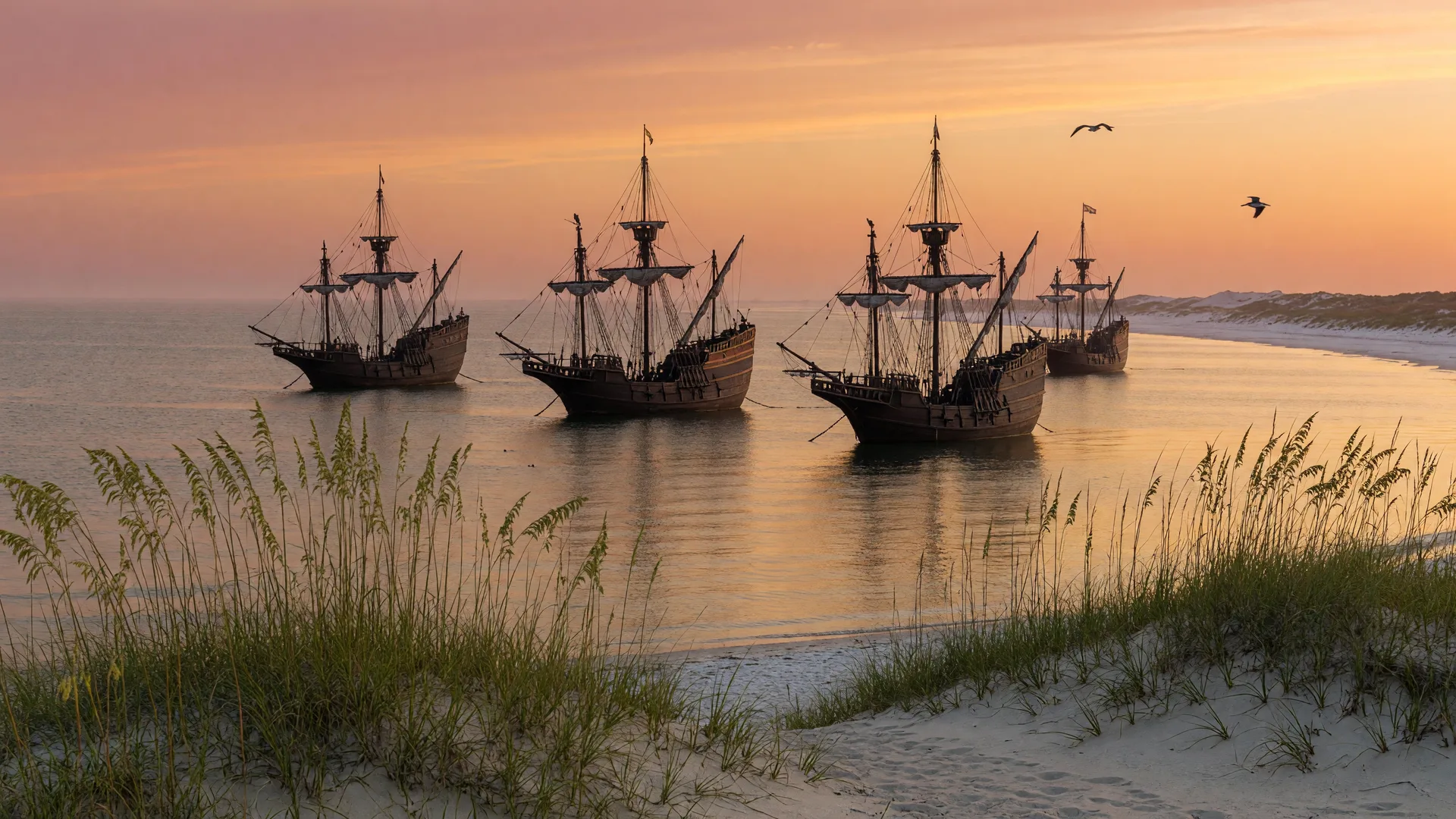
Anchorage imagined: the bay where Luna's fleet rode out its last summer
Pensacola's claim to be America's first settlement rests on a colony that lasted barely two years and then vanished: Santa María de Ochuse, founded by Tristán de Luna in 1559, six years before St. Augustine. A hurricane destroyed the fleet that was its lifeline, and the survivors were gone by 1561. The proof of that story has spent the last three decades coming up out of the bay, ship by ship, in the Emanuel Point wrecks that archaeologists keep finding in the shallow water off the city. It is a history you can stand inside at Plaza de Luna, walk along the America's 1st Settlement Trail, and carry all the way to the Spanish-named estate at 714 E La Rua St.
A colony six years older than St. Augustine
On August 15, 1559, the Spanish conquistador Tristán de Luna y Arellano sailed a fleet of about eleven ships into the bay the Spanish called Ochuse, carrying roughly 1,500 soldiers, colonists, and enslaved people from Veracruz. He founded Santa María de Ochuse on the high ground near the shore, the first serious European settlement attempt in what is now the continental United States, six years before Pedro Menéndez de Avilés founded St. Augustine in 1565 and two decades before Roanoke. St. Augustine earned the title of the oldest continuously occupied European city in the country. Pensacola holds the earlier claim: the first settlement, full stop.
The timing mattered as much as the place. Spain had recently secured a tenuous hold on the Gulf after the disasters of earlier expeditions, and Luna's orders were to plant a colony that could hold the coast and open a route inland toward the silver lands. He chose the bay Francisco Maldonado had scouted a decade earlier, the deep, protected harbor that would later anchor three empires and, finally, the modern city of Pensacola. The name of the bay and the town that grew beside it, Pensacola, descends from Panzacola, the name the native peoples used for the pines along these waters.
The hurricane that ended it
Luna's mistake was also his fleet's purpose: the ships were anchored in the bay and used as floating warehouses for the supplies the colony would need to survive its first year. In September 1559, about a month after landfall, a hurricane of the kind that still defines this coast swept into the anchorage and wrecked most of the fleet where it rode. Stores that had survived the crossing from Veracruz went to the bottom with the hulls, and the colony was left marooned on a shore it had barely begun to clear.
What followed was two years of starvation, desertion, and desperate supply by sea before the survivors were finally evacuated to Mexico in 1561. Santa María de Ochuse was abandoned, and the bay went quiet for nearly 140 years, until Spain returned to build a presidio in 1698 and the modern history of Pensacola began in earnest. But the colony did not disappear without a trace. It sank, and it waited.
Emanuel Point: finding the fleet, one ship at a time
The first of Luna's ships to be found, Emanuel Point I, was discovered in 1992 by the Florida Bureau of Archaeological Research, the team led by Dr. Roger Smith working from a tip that had been passed around for years: something old lay in the shallows near Emanuel Point, at the mouth of Bayou Texar. It was the wreck of a 16th-century Spanish vessel, the first physical proof that Luna's story was a shipwreck, not a legend.
Emanuel Point II followed in 2006, found by University of West Florida archaeologists running a magnetometer survey over the same stretch of bay floor. Then, in June 2016, UWF field-school students diving in the area discovered Emanuel Point III, a third ship from the lost fleet, announced that October. All three rest in shallow water, surprisingly well preserved under the same sand that once buried the settlement's hopes, and they are among the oldest European shipwrecks ever found in American waters.
The hunt is not over. Historical records suggest as many as six more vessels may have been lost in the same September storm, and the search continues each season as UWF's archaeology program extends its remote sensing across the bay. The wrecks themselves are active research sites, not open to the public, and the land settlement site, discovered in 2015, sits on a private residential lot. The story belongs to the public in a different way: through the museums and the walking trail that tell it.
Where the story is yours to visit
Start at Plaza de Luna, the bayside park at the foot of downtown that carries the expedition leader's name, then follow the America's 1st Settlement Trail, the chain of markers Visit Pensacola maintains downtown, to read the colony's full arc in place. The UWF Archaeology Institute in Pensacola keeps free public exhibits of the artifacts brought up from Emanuel Point, open Monday through Friday during business hours, and the Pensacola Museum of History and the T.T. Wentworth Jr. Florida State Museum both carry the Luna story in the context of the city's five flags.
What you will not find anywhere else in the country is the city itself: a modern, walkable downtown built directly on top of the first European settlement attempt in the United States, with the ships that carried it still lying in the bay a few miles from the marina. Most history is something you read. This one is something the tide goes over twice a day.
From Plaza de Luna to the gates of a Spanish-named estate
That same Spanish thread runs up the hill to the estate at 714 E La Rua St. Built in 1890, restored in 2014, and listed on the National Register in 2016 as the Marzoni House, the three-story Queen Anne in Old East Hill carries the name it still uses for the consular chapter of the early 1900s, when the property served as the Spanish Consulate: the direct descendant, in name and spirit, of the Spanish presence Luna planted on the bay more than three centuries earlier.
From Plaza de Luna at the water to the estate's front gate in Old East Hill is a short, mostly shaded walk through the city's oldest streetscapes. You pass Seville Square and its ring of 19th-century buildings, climb the streets the lumber boom lined with Queen Anne porches and turrets, and arrive at a working National Register estate: 7,574 square feet, twelve suites, 13.5 private baths, and a heated saltwater courtyard wrapped by two matched historic structures. It is the American settlement story, not preserved under glass, but operating, hosting guests, and for sale.
"Pensacola's history was nearly lost twice, once to a hurricane in 1559 and once to the wrecking ball in the last century. That the fleet and the houses of La Rua Street both survived to be found again is the whole argument for owning a piece of the first American coast."
Facts gathered from live sources in October 2026, including the UWF Newsroom record of the third shipwreck discovery, the UWF Archaeology Institute exhibitions page, Visit Pensacola's America's 1st Settlement Trail and Emanuel Point Shipwreck directory page, and the Pensapedia record of the Emanuel Point shipwrecks. Exhibit hours and visitor access change by season; confirm with each venue before you go.