
Neighborhood
Exploring North Hill: Pensacola's most beautiful historic neighborhood
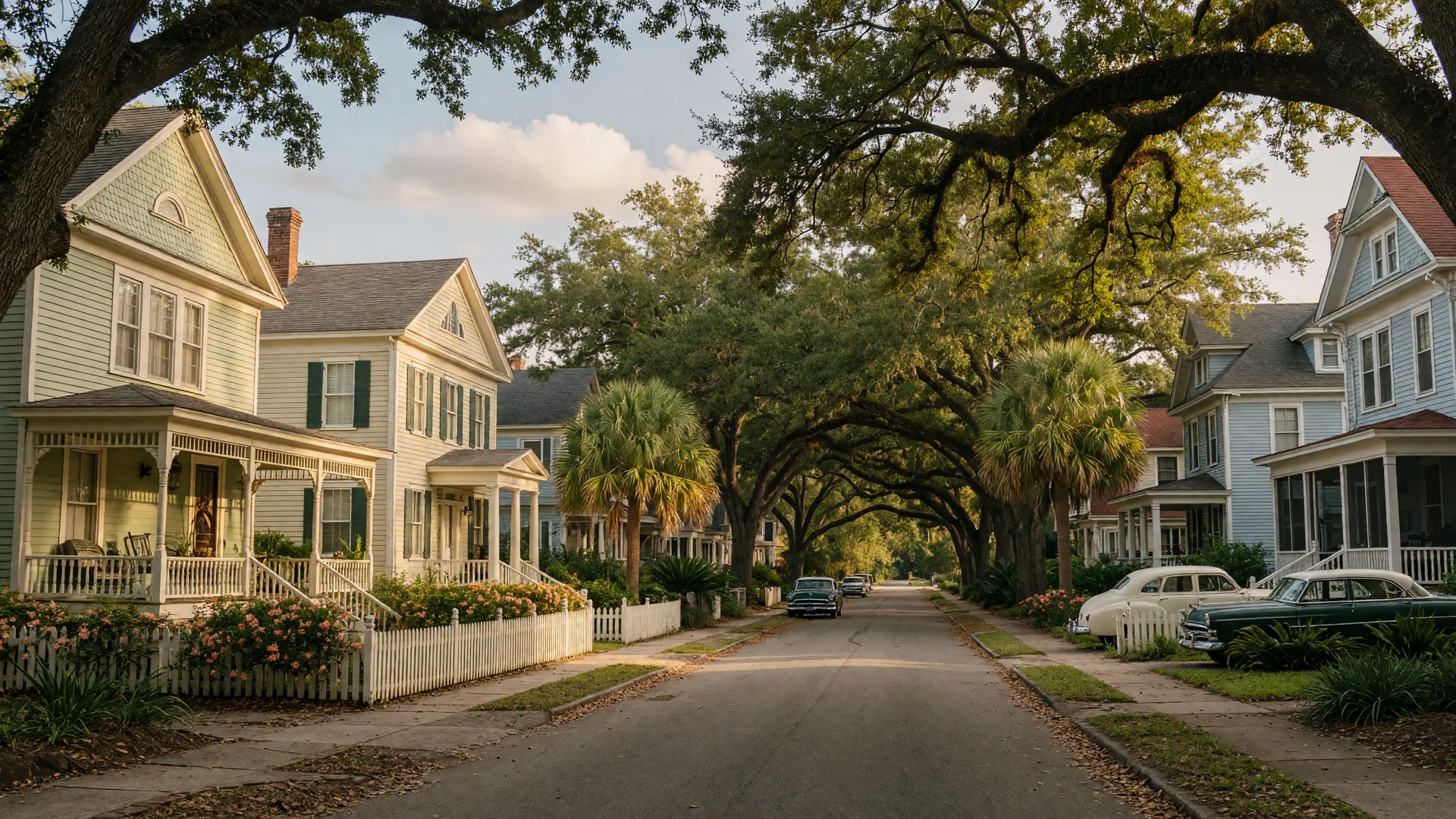
North Hill, a ten-minute walk from the estate
North Hill is the view from the top of Pensacola: a shaded hilltop district of more than 400 historic homes where the city's lumber-era elite built between the 1870s and the 1930s, and where, two centuries earlier, a British fort decided who would rule the Gulf Coast. Listed on the National Register of Historic Places in 1983, it is one of Florida's largest residential historic districts, and it begins about a ten-minute walk west of the front gate at 714 E La Rua St. Here is the neighborhood in full: its war, its money, its houses, and its calendar.
A hill that fought a war first
Long before the lumber barons, the hill belonged to soldiers. British engineers built Fort George in 1778 on the highest ground in town, and in 1781, at the height of the American Revolution, Spanish forces under Bernardo de Gálvez besieged and captured it, ending British control of West Florida and securing the Gulf for the young republic's allies. The campaigns became known as the Siege of Pensacola, a touchstone of Spain's contribution to American independence.
The battle site is now Fort George Memorial Park at 501 N Palafox St, one of the few places in the United States where a Revolutionary War battlefield has become a city park. A bronze equestrian monument to Gálvez anchors the district's southern edge at Palafox and Wright Streets, about half a mile west of the estate's gate, where you can stand on the ground where the city's oldest chapter was decided.
Lumber money built the view
After the Civil War, Pensacola rebuilt itself on yellow pine. The harbor crowded with lumber schooners, and the men who ran the mills, the banks, and the law firms built their homes up the hill, away from the docks, on grid streets platted with parks and planted with live oaks. North Hill grew in waves from the 1870s through the 1930s, and its residents were, by design, the city's upper middle class: merchants, lawyers, politicians, and the lumber magnates who steered the region's economy.
By the early 1970s, enough of that fabric was at risk that the neighbors organized. The North Hill Preservation Association was founded in 1972 and formally organized in 1974, the same year the city passed an ordinance describing the district's boundaries. In 1983 the district was listed on the National Register of Historic Places. Today the designation protects roughly 50 blocks and more than 400 historic buildings on about 155.6 acres, bounded by Blount Street to the north, Palafox Street to the west, Wright Street to the south, and Reus Street to the east, with Belmont and DeVilliers Streets forming part of the line. Exterior changes pass through the city's Architectural Review Board, which is exactly the point: the streetscape you walk today is the streetscape the city has promised to keep.
A street-by-street catalog of American house styles
What makes North Hill unusual among Florida historic districts is not age but range. Because homes went up continuously for six decades, the district reads like a catalog of American residential architecture: Queen Anne Victorians with turrets and fish-scale shingles, Neoclassical and Colonial Revival mansions with columned porticos, Tudor Revival half-timbering, Art Moderne streamlining, and rows of Craftsman bungalows. A single block can carry a century of shifting taste, all of it under one continuous canopy of mature oaks.
The estate at 714 E La Rua St belongs to the same chapter and the same provenance. Built in 1890 in the neighboring Old East Hill district, the Marzoni House is a three-story Queen Anne Victorian with an octagonal tower, built by the chief lumber inspector for the timber baron Henry Baars. Walk from the Gálvez monument at the edge of North Hill to the estate's turret and you cross, in about a mile, the finest surviving stretch of Pensacola's gilded lumber era.
Six houses worth a second look
The North Hill Preservation Association maintains a list of landmark homes worth a slow pass by sidewalk. Among the standouts: the Sol A. Levy House at 100 W DeSoto St and the nearby A. G. Moreno House at 116 W DeSoto St; the C. A. Weis House at 105 W Gonzalez St; the W. H. Watson House at 611 N Barcelona St; the Dr. Walter C. Payne House at 1125 N Spring St; and the William J. Forbes House at 903 N Spring St. They range from Queen Anne to early 20th century Revival styles, and most remain private residences, so the polite protocol is to admire from the sidewalk at a respectful distance.
A few blocks south, Florida Square at 602 N Palafox St is a memorial park established on another of the district's original green spaces. Known for generations as Lee Square, it was renamed Florida Square by the city in 2020, restoring the name it carried before the commemorations of the late 19th century. With Georgia Square to the east, it is a reminder that North Hill was platted as a neighborhood of parks, not just houses.
Walks, squares, and a trail of markers
The neighborhood rewards a walking tour, and the city has made one easy. The America's First Settlement Trail threads through downtown and up the hill; its marker No. 13, "Top of Palafox," stands beside Temple Beth El, one of the congregation landmarks of the district, near the North Hill Preservation District marker itself. Fort George Memorial Park, the Gálvez monument, and the two squares give the loop a beginning, a middle, and an end.
From the front gate of 714 E La Rua it is a level, shaded walk: head west on La Rua or Gadsden, cross the oaks, and you reach Wright and Palafox, the district's front door, in roughly ten minutes. Carry a water bottle, go in the morning when the light rakes across the porches, and give yourself two hours for the full circuit.
The neighborhood's calendar: the Tour of Homes
North Hill's signature event is the Historic North Hill Tour of Homes, produced each fall by the North Hill Preservation Association. The 2026 edition is scheduled for Sunday, November 29, with early-bird tickets at $30. On that Sunday a curated set of private houses opens their doors, and the district doubles as a museum of itself. Tickets and details are on the association's website, historicnorthhill.com, which also publishes maps, house histories, and neighborhood news year-round.
If your dates miss the tour, the exteriors are free on any other day of the year, and the association's maps make a self-guided walk easy. November is Pensacola at its mildest, which is another reason the Tour of Homes lands where it does.
What North Hill means for the estate at 714 E La Rua
The estate at 714 E La Rua St sits in Old East Hill, the neighboring district the city designated in 1992, and it carries its own National Register listing as the Marzoni House, conferred in 2016. North Hill and Old East Hill are two halves of one protected landscape: the same 1870 to 1920 building boom, the same oak canopy, the same review boards, the same scarcity.
That scarcity is the quiet investment story of this whole quarter of Pensacola. Historic districts cap the supply of exactly what they protect: restored Victorian and Revival-era homes within walking distance of downtown. None of that supply is being built again, and demand for it only compounds as the city's tourism and hospitality economy grows. For a buyer weighing a twelve-suite National Register income estate, the neighborhood is not a footnote. It is the moat around the asset.
"North Hill and Old East Hill are the only kind of neighborhood America still caps by design. The supply is fixed, the trees get taller, and the houses keep their grade."
Facts gathered from official and historical sources in September 2026, including the North Hill Preservation Association, the National Register nomination on file at the NPS NPGallery, the WUWF community calendar for the 2026 Tour of Homes, and Visit Pensacola. Confirm tour dates and ticket prices with the association before you travel.