
Architecture
Victorian Architecture in Pensacola: discover the homes that tell our story
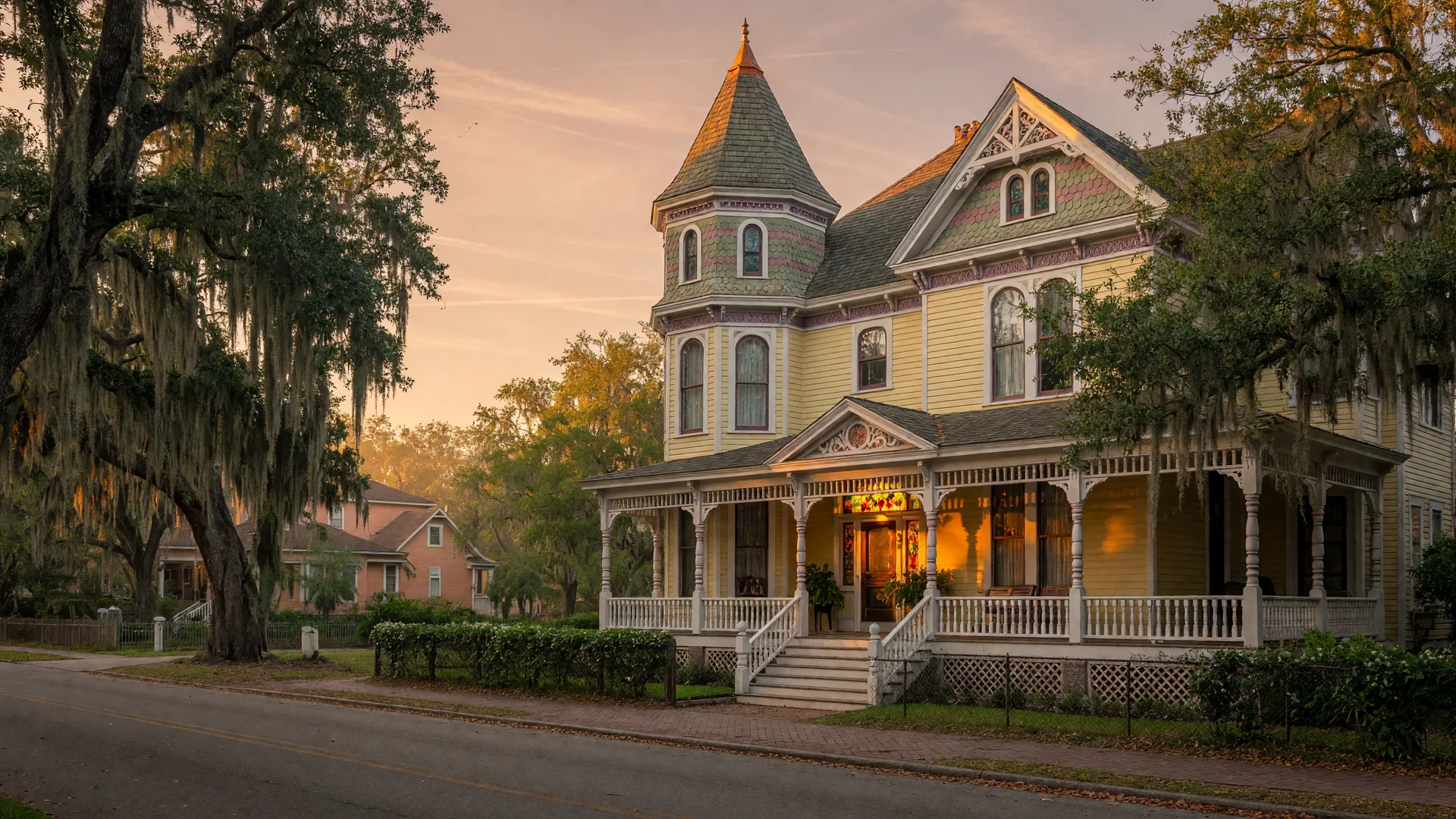
The Victorian vocabulary, still on its original lots
Pensacola's Victorian chapter was brief, loud, and built almost entirely in wood. From the arrival of the railroads in the 1870s to the peak of the yellow-pine lumber boom around 1900, the city rebuilt itself in Queen Anne towers, Folk Victorian porches, and Greek Revival survivors dressed in fresh gingerbread. The districts survive almost whole: more than 400 homes in North Hill, more than 300 in Old East Hill, and a museum row in Seville Square. The estate at 714 E La Rua St, a Queen Anne built in 1890 at the top of that boom, sits at the exact center of the story. Here is how to read the style, and where the best of it still stands.
Why Pensacola turned Victorian
Before the lumber boom, Pensacola was a small port town with a long colonial past and a modest skyline. The turning point came in the 1870s, when railroads reached West Florida and opened the region's timber and naval-stores industries, the turpentine trade among them. Ships from foreign ports crowded the harbor to load yellow pine, and within two decades the city had transformed from an isolated frontier town into an industrialized regional trade center. The prosperity showed up as houses: mill owners, lumber merchants, bankers, and lawyers built up the hill, away from the docks, on streets platted with parks and planted with live oaks.
The boom peaked around 1900 and then cooled as the lumber industry declined, which is what makes Pensacola so legible today. The city's Victorian era fits into roughly thirty years, so the architecture reads as one clear chapter rather than a jumble of centuries. And because the era's money and its building material were the same commodity, the houses were framed, floored, and trimmed in the local yellow pine that had paid for them in the first place. The market's wealth and the neighborhood's fabric came out of the same harbor.
How to read a Queen Anne
Queen Anne was the most theatrical of the Victorian styles, and it is the style Pensacola's boom years loved best. Look for the telltales: an octagonal corner turret or tower, steep hipped roofs crossed by gables, deliberately asymmetrical massing, a deep wraparound porch, turned spindle posts and jig-saw or scroll-sawn gingerbread trim, gables finished in fish-scale wood shingles, and stained glass in transoms and stair landings. Where a Federal or Greek Revival house was balanced and calm, a Queen Anne was built to be noticed, and the more it showed off, the higher its owner sat in the boom economy.
Pensacola built other Victorian voices too. Folk Victorians, the carpenter's version of the style, wrapped simpler gabled houses in jig-saw porches and decorative gable vents. Greek Revival houses from the 1840s and 1850s were remade with Victorian trim and floor plans. Gothic Revival windows turn up on churches and a few houses. Walk a North Hill or Old East Hill block and you can find all of them under one canopy of oaks, which is exactly what the era's builders intended: a neighborhood that announced prosperity in endless variations on the same exuberant theme.
Where the style survives
Three addresses carry the bulk of Pensacola's Victorian fabric. North Hill, listed on the National Register of Historic Places in 1983, is one of Florida's largest residential historic districts, with more than 400 historic buildings across roughly 155 acres built in waves from the 1870s through the 1930s. Old East Hill, the city-designated district the estate anchors, holds more than 300 restored homes from the same 1870 to 1920 window. And downtown, around Seville Square and Palafox Street, the historic districts count roughly 500 buildings spanning the same styles, with Historic Pensacola Village at their core.
One boom, three addresses. The practical difference is how the protection works: North Hill is a National Register district with a city Architectural Review Board, Old East Hill is protected by city ordinance with its own review, and the downtown museums are managed one house at a time. Together they guarantee the thing the era left behind, its streetscapes, stays essentially as the lumber years made it.
A walking guide to the houses that tell the story
The best place to start is the house this site exists to show. The estate at 714 E La Rua St, the Marzoni House, is a three-story Queen Anne built in 1890 for Louis D. Marzoni, chief lumber inspector for the timber baron Henry Baars, with an octagonal corner tower and interiors finished in woodwork from the Baars mills. By 1900 the plan had doubled. During the Spanish-American War the house served as the Spanish Consulate in Pensacola, the chapter that gave it the name that stuck, and after a meticulous restoration in 2014 it was listed on the National Register of Historic Places on May 10, 2016. It is the most complete privately owned example of the style left in the city, and it is open by appointment. The full consulate history is its own essay.
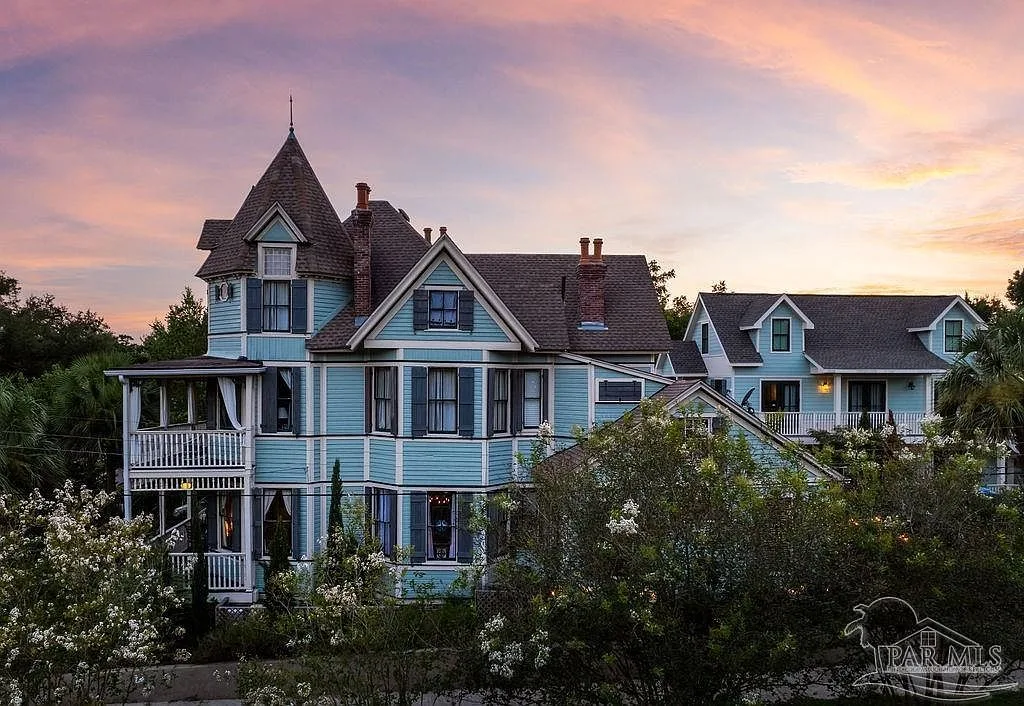
The Marzoni House, 1890 · twelve suites inside a National Register shell
From the estate, the rest of the era is a short walk. A few blocks south in Seville Square, the Dorr House at 311 S Adams St was built in 1871 by Clara Barkley Dorr, a widow of the lumber industry, for herself and her five children. It pairs a Greek Revival exterior with a Victorian-era floor plan, is built of local yellow pine and brick, and has stood on the National Register since 1974. Around the corner, the Lear/Rocheblave House at 214 E Zaragoza St is a two-story Folk Victorian from 1890, finished in jig-sawed porches and Queen Anne ornament, and best known for the years its second owners, tugboat captain Benito Rocheblave and his wife Catherine, spent there at the turn of the century.
Up in North Hill, the Thomas W. Finch House at 14 W Gadsden St is a c. 1900 Queen Anne that old-house enthusiasts still talk about for its 13-foot ceilings and four kitchens, and a c. 1896 Queen Anne nearby was built by the noted Pensacola builder Charley Hill Turner, whose later downtown projects included the Blount Building and the Saenger Theatre. For the era's quiet preface, cross to the Quina House at 204 S Alcaniz St, Pensacola's oldest building still on its original site, dating to 1821 and possibly earlier, a one-and-a-half-story Spanish-period cottage of pine, cypress, and oak on brick piers. If the Marzoni House is the style at full volume, the Quina House is the silence before it began.
The houses you can walk inside
Most of Pensacola's Victorian houses are private homes, and the polite protocol is to admire from the sidewalk. For interiors, Historic Pensacola Village runs the Historic House Tour, a guided walk offered Tuesday through Saturday at 11:00 a.m., 1:00, and 2:00 p.m., meeting at the entrance to the Museum of Industry. In about ninety minutes it visits the Dorr House, the Lear/Rocheblave House, the Lavalle House, and Old Christ Church, which means two of the houses above plus two more of the district's landmarks, told by real guides.
The Quina House is a separate, free museum run by the Pensacola Historic Preservation Society at 204 S Alcaniz St, open with donations and a phone call at (850) 432-3050, showing period interiors from the 1790s through the 1880s. And the exteriors are free every day: North Hill's streets, the America's First Settlement Trail through the downtown districts, and each fall the Historic North Hill Tour of Homes, covered in our North Hill essay.
What the style means for the estate at 714 E La Rua
Nothing like these houses is being built again, and that is the quiet investment fact of Pensacola's Victorian chapter. A National Register house is capped in supply by law, a twelve-suite National Register income property is capped again, and the districts that protect the streetscape guarantee the setting stays fixed while demand only grows. The estate at 714 E La Rua St is 7,574 square feet, 12 suites, and 13.5 baths on a 0.31-acre compound, operating today as a five-star short-term rental, and it carries its historic status as a working asset, not a museum piece.
For a buyer, that is the whole argument in one sentence: Pensacola wrote its richest era in yellow pine, never built another one, and protected what remains. The Old Spanish Consulate is one of the few houses in the city where you can own the era outright, and the only one running a twelve-suite hospitality operation inside the walls.
"Pensacola wrote its richest era in lumber and never built a second one. A Queen Anne in this town is not just architecture, it is the thirty years that made the city, still standing on its original lot."
Facts gathered from official and historical sources in September 2026, including Historic Pensacola's Dorr House record, its Lear/Rocheblave House record, the Pensacola Historic Preservation Society's Quina House page, the Visit Pensacola guide to historic homes, and the City of Pensacola Historic Preservation office. Confirm tour times with Historic Pensacola before you visit.